
If you’re currently staring at your phone in a dark room while your baby tries to use your knuckle as a chew toy, I feel you. Honestly, I’ve been there—twice. My name is Joy, and while I can’t physically hand you the massive cup of coffee you probably need right now, I can at least tell you that you’re not crazy and this “drool phase” won’t last forever. I remember with my first, I kept checking his gums every ten minutes like a watched pot that would never boil. I was convinced he’d be the only kid in kindergarten with zero teeth.
The biggest lie we’re sold as new parents is those neat little charts you see on Pinterest. You know the ones: “Bottom teeth at 6 months, top teeth at 8 months.” It sounds so organized, right? But here’s the reality: babies don’t read those charts. My second daughter didn’t show a single white speck until she was nearly eleven months old, while a friend of mine had a baby born with a “natal tooth” already in place. The baby teething timeline is a lot more like a “choose your own adventure” book than a scheduled train arrival. Every baby runs on their own internal clock, and trying to force yours into a textbook mold is just a recipe for a 3:00 AM meltdown—for both of you.
The “Pre-Game” Phase: When the Drool Hits the Fan
Most moms start seeing “the signs” way before a tooth actually breaks the surface. Around the 3 or 4-month mark, the “Big Drool” usually begins. I’m talking soaked-through-three-bibs-an-hour kind of drool. This is where most people get confused. I see it all the time in mom groups: “My 3-month-old is teething!” Well, maybe—but usually, it’s just their salivary glands waking up and them finally “discovering” their hands.
The actual baby teething timeline usually doesn’t kick into high gear until somewhere between 6 and 10 months. But honestly, I’ve seen teeth pop at 4 months, and I’ve seen them wait until after the first birthday. If your baby hits 12 months and is still all gums, don’t panic. My pediatrician used to joke, “Have you ever seen a teenager without teeth?”. It sounds a bit snarky, but it’s the best advice I ever got—it lowered my stress levels immediately.
One thing 99% of people get wrong is assuming that a high fever or serious diarrhea is “just teething”. I fell for this too. I thought my son’s 102-degree fever was just a stubborn molar, but it turned out to be a double ear infection. While a slight “warmth” (around 99°F) can happen from gum inflammation, a real fever is usually a sign of a bug. Don’t let the teething label mask something that actually needs a doctor’s eye.
The Main Event: Which Teeth Show Up and When?
When the teeth finally decide to make an appearance, they usually follow a “bottom-to-top” pattern. Those two adorable little bottom front teeth—the lower central incisors—are usually the first guests of honor. They typically pop out between 6 and 10 months, followed by the top front teeth a couple of months later.
Once those top ones come in, the “biting phase” really begins. I have a very vivid (and painful) memory of my daughter testing her new top teeth out on me during a nursing session. Let’s just say I screamed, she cried, and we both had a very long night. After the front four are in, you usually get a little breather before the first molars show up around the one-year mark.
These molars are the real villains of the baby teething timeline. Unlike the sharp front teeth that slice through the gum like a little knife, molars are flat and blunt. They don’t slice; they push. It’s a slow, agonizing process that often involves your baby rubbing their cheeks or pulling at their ears because of the pressure in the back of their jaw. This is when I realized my old-school ring teethers weren’t cutting it anymore—they couldn’t reach back far enough.
Survival Tactics: What Actually Works (and What’s Total BS)
I’ve tried every “hack” in the book. I’ve been that mom at 2:00 AM trying to tie a frozen washcloth into a knot while half-asleep. Speaking of washcloths—don’t freeze them rock solid. I made that mistake once and I’m pretty sure it stuck to my poor kid’s lip like that scene from A Christmas Story. Just get it damp and put it in the fridge. That cool, bumpy texture is a godsend for itchy gums.
And can we talk about amber necklaces for a second? I’m going to be blunt: they are a huge “no” for me. I know they look cute and “boho,” but the FDA has been screaming about the strangulation and choking risks for years. I don’t care what the influencers say; it’s not worth the risk. Stick to 100% food-grade silicone. It’s safe, it’s squishy, and you can actually sanitize it without it falling apart.
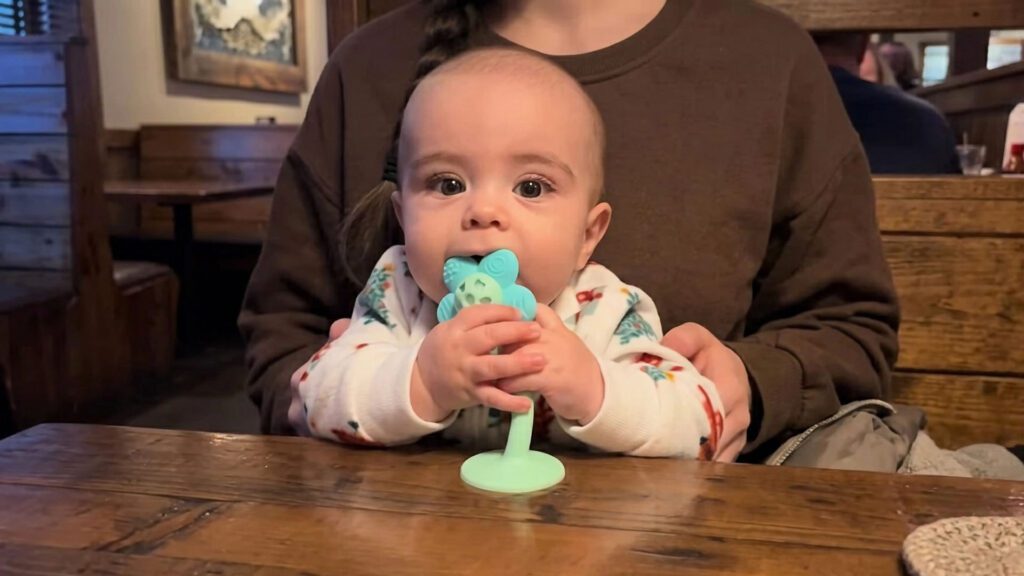
Another thing I’ve learned? Distraction is a legitimate medical intervention. When the pain is at its peak, sometimes just changing the environment helps—take them outside, put them in a lukewarm bath, or give them a “sensory” teether that makes a little noise. Our Joyfulia Sunnyflower Teetther Rattle is my go-to for this because it suctions to the high chair. They can chew on the “petals” and shake the rattle, which often breaks the “pain loop” in their brain for a few minutes—just enough time for you to finally eat a piece of toast.
One last thing—don’t be a hero. If you’re exhausted and the baby is miserable, it’s okay to feel overwhelmed. Teething is a marathon, not a sprint. The baby teething timeline lasts until they are about two or three years old when those second molars finally arrive. It feels like forever when you’re in the thick of it, but I promise, one day you’ll realize you haven’t seen a teether in months, and your “baby” is suddenly eating a whole apple.
If you’re currently dealing with a “drool apocalypse,” welcome to the comments. Which tooth are you fighting right now? Are you in the “bottom two” phase or the “molar madness” stage? Drop a comment below and let’s vent together—I see you, Mama, and you’re doing a great job.